White, pink, and brown noise — in your browser
Press play. The sound is generated in your browser, so nothing downloads and nothing ever repeats.
White noise
Paused
Warning: volume is at 100%. Keep it low to protect your hearing.
Press play. Nothing downloads — the sound is generated in your browser.
Noise Machine is a free browser-based noise generator that synthesises white, pink, and brown noise in real time using the Web Audio API. It requires no account, streams nothing, and works offline after the first visit. The same generator ships as a paid Android app.
What a noise colour actually is
“Noise colour” describes how a sound’s energy is spread across the frequency range. It is a description of a spectrum, not a brand name — the same three colours mean the same thing in an audio textbook as they do here.
White noise contains equal power at every frequency. Because each octave up the scale is twice as wide as the one below it, that flat-per-hertz spectrum puts progressively more energy into the high octaves. This is why white noise sounds bright and hissy, like an untuned radio, and why it is effective at covering the frequencies human speech occupies.
Pink noise reduces power in proportion to frequency, so every octave carries the same total energy. The result sounds balanced rather than bright — closest to steady rain or wind through trees. Most sounds in nature fall roughly along this curve, which is the usual explanation for why people describe pink noise as the most comfortable of the three.
Brown noise — also called red or Brownian noise, after Brownian motion rather than the colour — drops off twice as steeply again. Nearly all of its energy sits at the bottom of the range, giving the deep rumble people compare to distant surf, a waterfall, or a plane cabin.
Choosing between them
Nobody needs to know the maths to pick one. The practical differences:
- If a noise is too harsh or tiring, move down the list: white to pink, pink to brown.
- If a noise isn’t covering the thing that bothers you, move up. White noise masks speech, keyboards, and sudden sharp sounds far better than brown.
- For low-frequency intrusions — traffic, a neighbour’s bass, an air conditioner — brown noise sits in the same range and hides it best.
- For sleep, most people converge on pink or brown; for focus and open offices, white and pink.
Switch colours while it plays. The generator swaps underneath without a gap, so you can compare them directly on whatever you are actually trying to block out.
Generated, not streamed
Almost every noise track online is a recording: a few minutes of audio, looped. Loops are cheap to serve, but they have a seam, and once you have noticed the seam you cannot un-notice it. It stops being a texture and becomes a rhythm.
This player does what the Android app does — it synthesises the noise sample by sample as it plays, using the Web Audio API. White noise is a fresh random value per sample; pink noise runs those values through Paul Kellet’s filter; brown noise integrates them and leaks the result slightly to keep it centred. Nothing is downloaded, nothing is stored, and nothing repeats, because there is no recording to repeat.
It also means the player costs no bandwidth after the page loads, and works with the network off entirely.
Common uses
People reach for generated noise for a fairly narrow set of reasons, and it is worth being clear about which ones are well supported and which are not.
Masking unwanted sound is the use with the least ambiguity. Noise works here for a straightforward acoustic reason: it raises the background level so that speech, traffic, or a neighbour’s television no longer stands out against silence. This is the same principle office sound-masking systems use.
Sleep and relaxation is the most common use and the evidence is genuinely mixed. Reviews of the research consistently find the studies small and inconsistent, and continuous overnight sound is not recommended for everyone. Plenty of people find it helps them; that is a reasonable thing to try, and not a claim about what it does.
Focus and study is similar — widely done, weakly evidenced, and highly personal. Some people concentrate better with a steady background; others find any sound worse than none.
Tinnitus management sometimes uses broadband noise, but it should be done on the advice of an audiologist rather than picked up from a website.
If you are using noise around an infant, follow the safety guidance from a paediatrician on volume and distance from the crib. Play it quietly, across the room, and not all night.
Which noise should you use?
| Noise | What it sounds like | Energy per octave | Commonly used for |
|---|---|---|---|
| White noise | A flat hiss, like an untuned radio | Rises 3 dB per octave | Masking speech and sudden noises |
| Pink noise | Softer hiss, like steady rain | Flat across octaves | Sleeping and long listening sessions |
| Brown noise | A deep rumble, like distant surf | Falls 3 dB per octave | Blocking low-frequency noise and focus |
The same noise, on Android
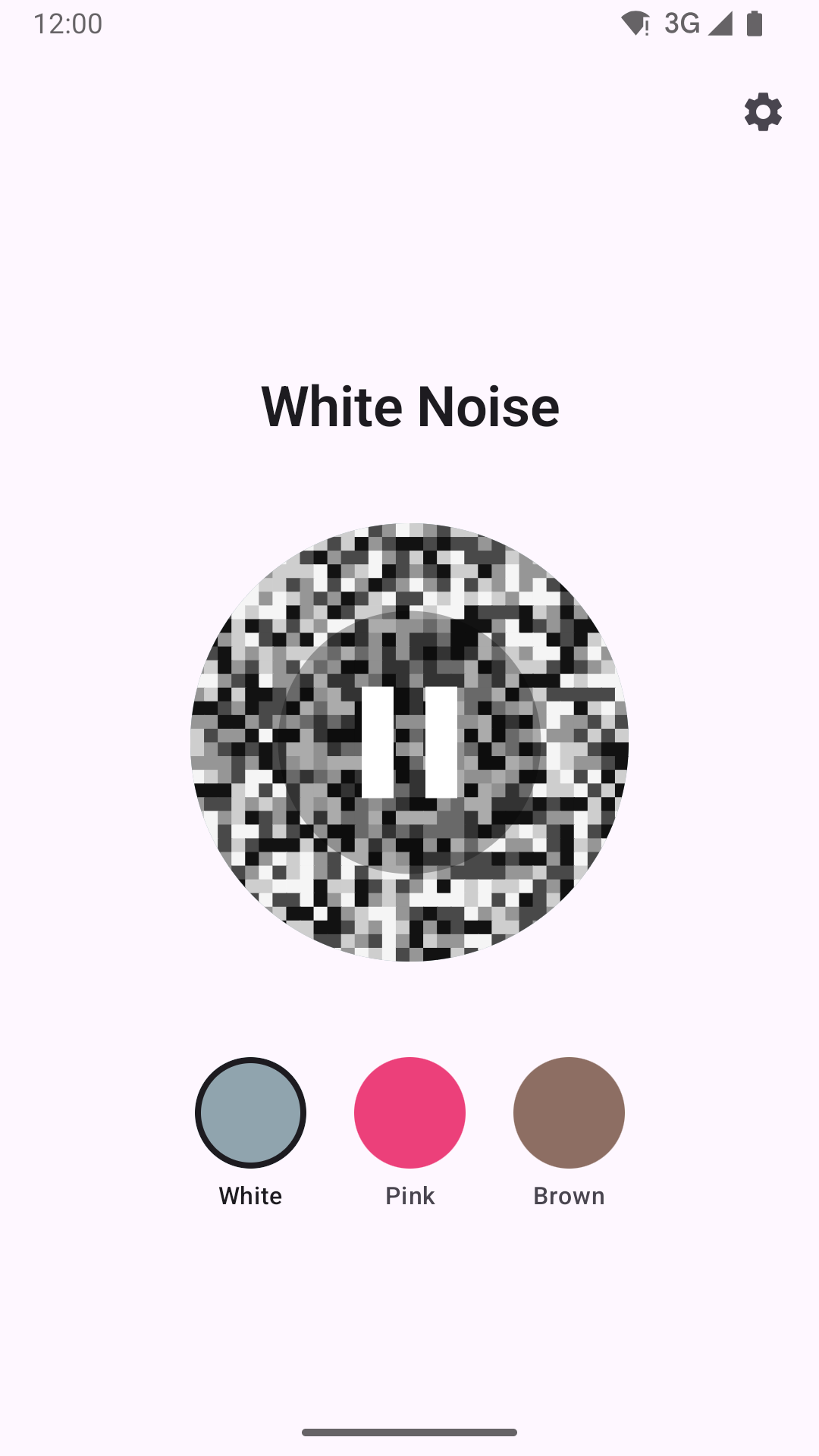
Take it offline. One button, background playback, lock screen controls, and a home screen widget. No ads, no account, no subscription.
- Pay once, keep it forever
- No ads and no tracking inside the app
- No internet permission — it works fully offline
- Keeps playing when the screen is off
- Home screen widget and lock screen controls
- Plays on Wear OS watches on their own

One-time purchase, about $0.20. Price varies by country.
Questions
Is this white noise generator free?
Yes. The player is free and needs no account, no sign-up, and no time limit. There are no ads on this site and no third-party scripts of any kind. The Android app is a separate one-time purchase of roughly 20 cents.
Does the noise loop or repeat?
No. The audio is synthesised sample by sample in your browser rather than played back from a recording, so there is no loop point and no repeating pattern, however long you listen. Looping is the usual reason a noise track starts sounding like a rhythm after twenty minutes.
Does it work offline?
Yes, after the first visit. The page installs a service worker that caches itself, and because the sound is generated locally rather than streamed, the player keeps working with no connection at all. You can also install the page as an app from your browser menu.
Will it keep playing if I lock my phone or switch tabs?
Switching tabs is fine — audio keeps playing and only the animation pauses to save battery. Locking the phone is where browsers differ, and most will suspend a web page eventually. That limitation is the main reason the Android app exists.
Which noise colour is best for sleep?
Most people who compare them settle on pink or brown for sleep and white for masking speech. Pink and brown put more energy in the low frequencies, which many listeners find less fatiguing over a full night. There is no single right answer, which is why the player lets you switch between all three while listening.
How loud should I play it?
Quiet enough that you could hold a conversation over it. Noise used for sleep or focus is meant to sit under everything else, and playing it loudly for hours is a hearing-safety question rather than a comfort one. Start at the lowest level that masks whatever is bothering you.
Does this collect any data about me?
The player does not send playback data anywhere. The site does count page views server-side, without browser analytics, cookies, or your IP address in the counting request. Your colour and volume stay in your own browser, and there is no account to attach them to.
What is the difference between this and the Android app?
The same three generators, the same sound. The app adds true background playback with lock-screen controls, a home-screen widget, a Wear OS watch app, no ads, and no internet permission at all. The web player is the free way to try before deciding whether that is worth roughly 20 cents.