Pink noise generator
Softer than white noise, like steady rain. Generated live — no loop, no download.
Pink noise
Paused
Warning: volume is at 100%. Keep it low to protect your hearing.
Press play. Nothing downloads — the sound is generated in your browser.
A free browser pink noise generator. Pink noise carries equal energy in every octave, which makes it sound balanced rather than hissy and is why listeners often prefer it to white noise for sleep and long sessions. This player synthesises it in real time using Paul Kellet's filter, the same code the Android app runs.
What pink noise is
Pink noise has a power spectral density that falls in inverse proportion to frequency — the relationship usually written 1/f. Double the frequency and the power halves.
The consequence is the useful part. That falling curve exactly cancels the fact that octaves get wider as you go up, so every octave ends up carrying the same total energy: as much between 100 and 200 Hz as between 5,000 and 10,000 Hz. Human hearing is roughly organised by octaves, so a spectrum that is flat per octave is the one that sounds flat to us. White noise is flat on paper; pink noise is flat to the ear.
Why people prefer it
The high-frequency emphasis that makes white noise an effective speech masker is also what makes it tiring after a while. Pink noise trades some of that masking power for comfort, and for long sessions most people find the trade worth making. It is the colour listeners tend to converge on when they have tried all three over a period of nights rather than minutes.
The resemblance to rain, wind, and moving water is not a coincidence either. Many natural broadband sounds fall roughly along a 1/f slope, and 1/f patterns show up well beyond acoustics — in heartbeat intervals, in river flow rates, in the statistics of music. Whether that familiarity is why pink noise feels comfortable is speculation, but the familiarity itself is real.
What the research supports
This is where it is worth being careful, because pink noise attracts confident claims it cannot support.
There are small studies suggesting that pink noise delivered in short bursts, timed to the slow brain waves of deep sleep, may affect sleep depth and next-day memory. They are interesting. They are also small, short, mostly conducted in labs with equipment that tracks the sleeper’s brain activity in real time, and they are not a finding about leaving a phone playing noise on a nightstand. Broader reviews of continuous noise for sleep report low-certainty evidence and inconsistent results.
What can be said plainly: pink noise raises the background level, and a raised background level genuinely does mask intrusive sound. That mechanism is not in dispute. Everything past it is worth trying rather than believing.
How this generator makes it
Filtering random noise into a 1/f slope is harder than it looks, and the straightforward approaches are either expensive or drift out of balance.
This player uses Paul Kellet’s refined method, the same one in the Android app: six one-pole filters running in parallel over a white noise source, each tuned to a different corner frequency, summed with a small direct contribution. Together they trace the 1/f curve closely across the audible range at a cost of a few multiplications per sample.
The filter state carries across audio blocks continuously. That detail matters more than it sounds — resetting those six values between blocks would put a tick into the output at a steady rate, and a periodic tick is precisely the thing generated noise is supposed to avoid.
Pink, white, or brown
Pink sits in the middle by design. If it is not masking enough, go up to white; if it is still too bright, or the problem is traffic and bass rather than voices, go down to brown. The swatches switch colours without stopping playback, so the comparison takes seconds.
Which noise should you use?
| Noise | What it sounds like | Energy per octave | Commonly used for |
|---|---|---|---|
| White noise | A flat hiss, like an untuned radio | Rises 3 dB per octave | Masking speech and sudden noises |
| Pink noise | Softer hiss, like steady rain | Flat across octaves | Sleeping and long listening sessions |
| Brown noise | A deep rumble, like distant surf | Falls 3 dB per octave | Blocking low-frequency noise and focus |
The same noise, on Android
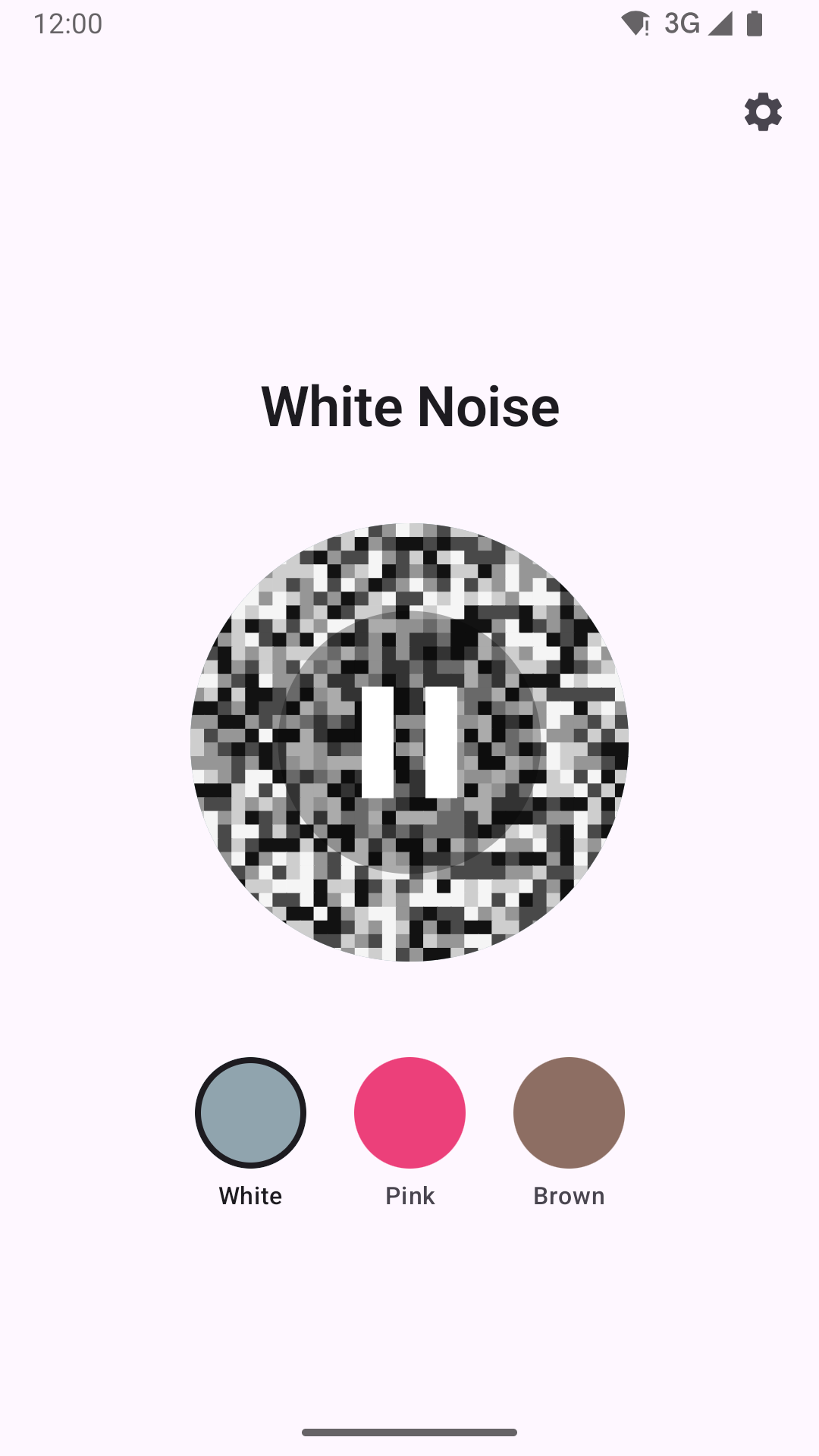
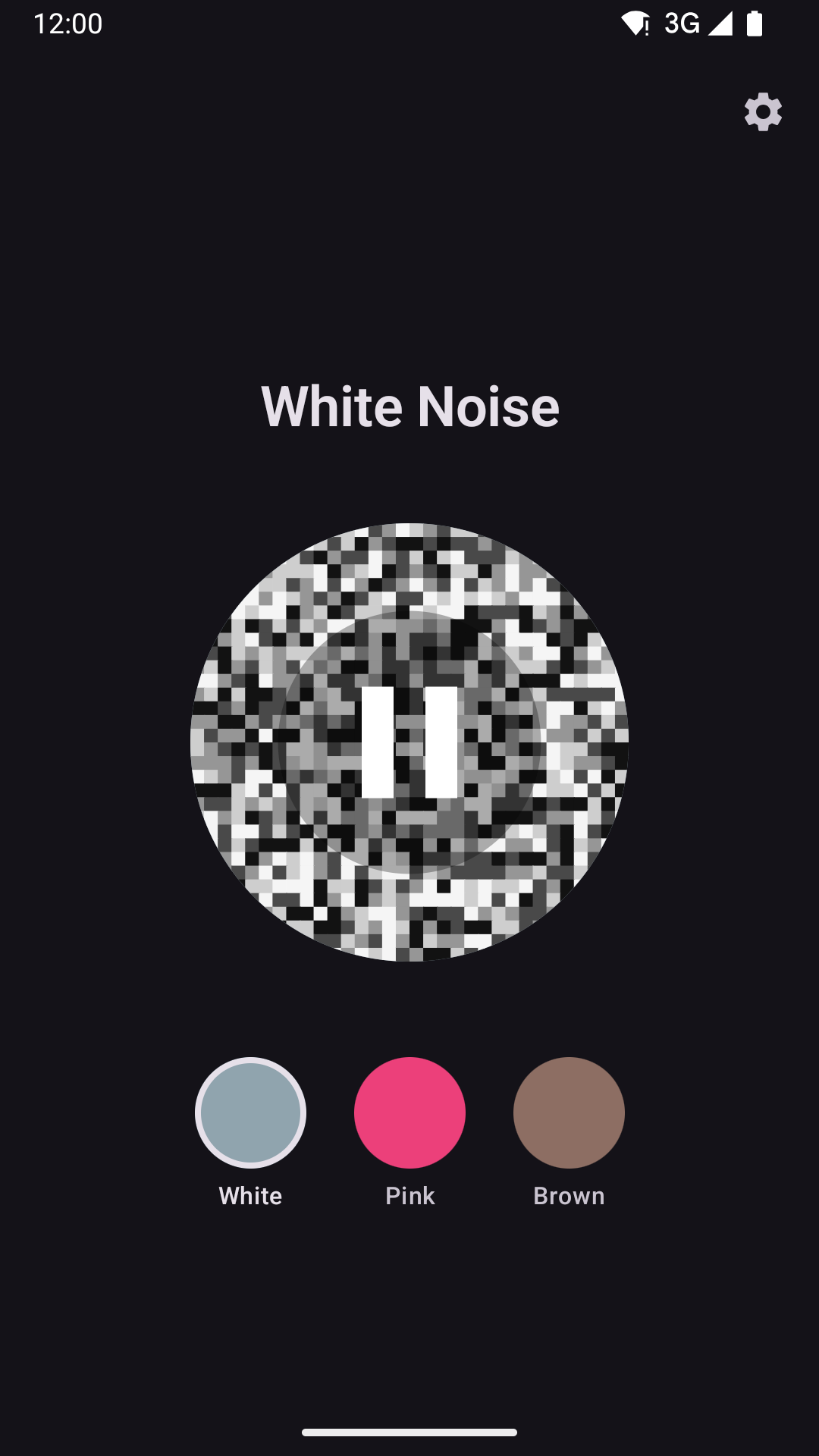
Take it offline. One button, background playback, lock screen controls, and a home screen widget. No ads, no account, no subscription.
- Pay once, keep it forever
- No ads and no tracking inside the app
- No internet permission — it works fully offline
- Keeps playing when the screen is off
- Home screen widget and lock screen controls
- Plays on Wear OS watches on their own

One-time purchase, about $0.20. Price varies by country.
Questions
What is pink noise?
Pink noise is a sound whose power falls in inverse proportion to frequency, so that every octave carries the same total energy. That balance is what makes it sound even across the range rather than bright at the top, and it is why pink noise is often described as the most natural-sounding of the three noise colours.
What does pink noise sound like?
Steady rain, wind through trees, or a waterfall heard from some distance. It is recognisably the same kind of sound as white noise but with the harshness taken out — full rather than hissy.
Is pink noise better than white noise for sleep?
Many people find it more comfortable over a full night, because it does not concentrate energy in the high frequencies the way white noise does. Whether it actually improves sleep is a weaker claim: the studies are small, short, and inconsistent, and reviews do not support strong conclusions. Comfort over hours is a reasonable thing to optimise for on its own.
Why is it called pink noise?
By analogy with light. A spectrum weighted towards the low end of the visible range looks red, and pink noise is white noise tilted towards its low end — less far than red, hence pink. Brown noise, confusingly, is not named after a colour at all but after Brownian motion.
What is the difference between pink noise and 1/f noise?
They are the same thing. Pink noise is defined by a power spectral density proportional to 1/f, and the two names are used interchangeably in acoustics and signal processing. The 1/f pattern also turns up in a striking range of unrelated natural systems, which is part of why it has attracted so much attention.
Is this pink noise generator free?
Yes, with no account, no limit, and no ads. The Android app is a one-time purchase of roughly 20 cents.